
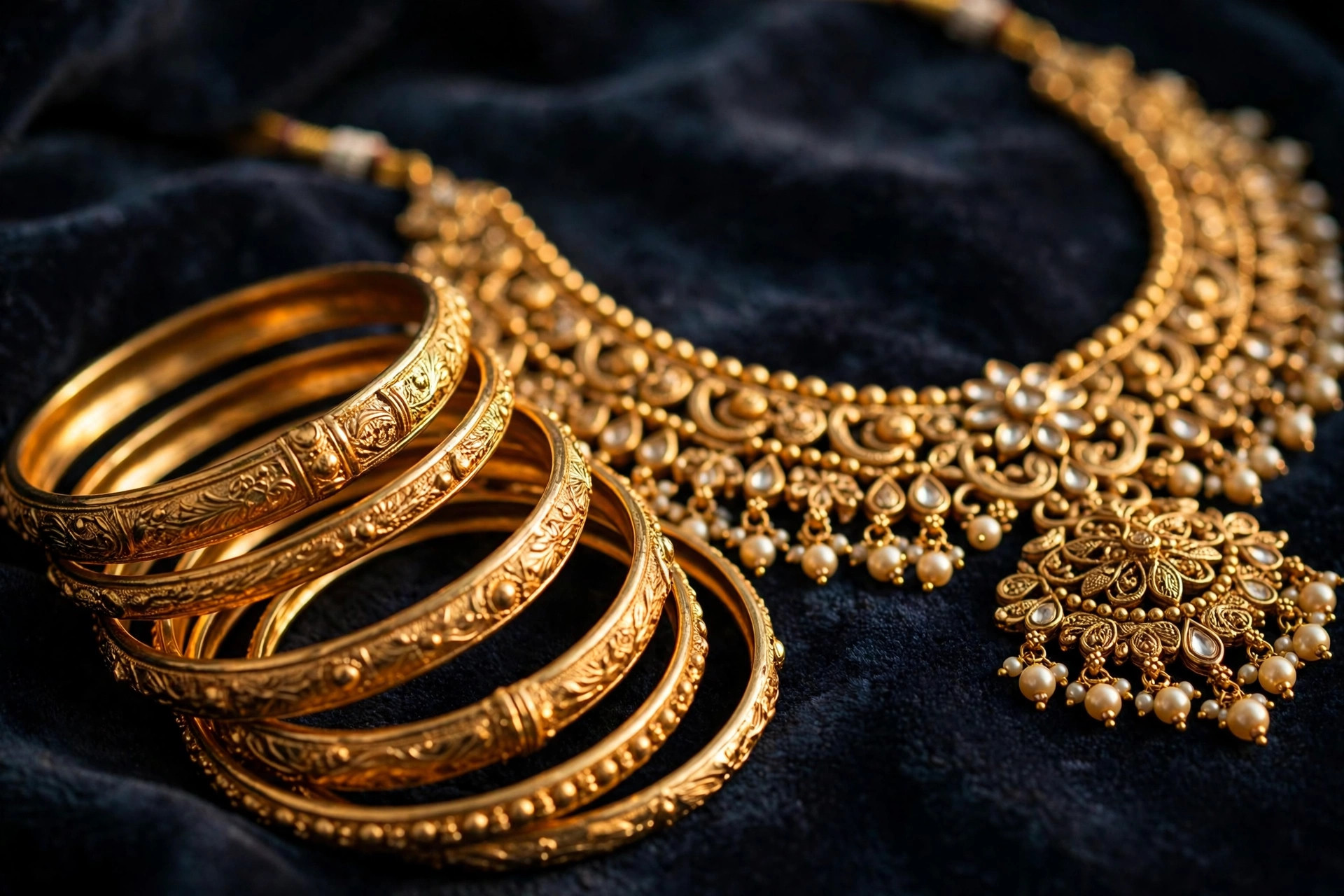
If you buy jewellery in Pakistan, you will almost certainly buy 22-karat gold. It is the standard for bridal sets, bangles and most traditional pieces. Yet many buyers do not know what 22 karat actually means, how it differs from 24 karat, or why a 22-karat piece is not priced at the 24-karat rate.
This guide explains 22-karat gold in plain terms, so you can buy with confidence.
What 22 karat means
Karat measures purity out of 24 parts. 24 karat is pure gold. 22 karat means 22 parts gold and 2 parts other metals, which is 91.6 percent gold. That alloy is often marked 916, which is the same figure expressed as a hallmark number.
The other metals are not a trick — they make gold harder and more durable. Pure 24-karat gold is soft and scratches easily, which is why it is rarely used for jewellery that will be worn every day. 22 karat strikes a balance: it is still mostly gold, but strong enough for rings, bangles and sets.
22 karat vs 24 karat
The most important difference for buyers is price. Because 22-karat gold contains less pure gold per gram, its rate per tola or gram is lower than the 24-karat rate. Confusing the two is a common and expensive mistake.
When a shop quotes you a rate, ask clearly: is this the 22-karat rate or the 24-karat rate? Check the live 22-karat rate on Pakistan Gold Market on the day you buy, and use the calculators to estimate the value for your exact weight. If a quote for a 22-karat piece is close to the 24-karat rate, ask why — the difference should be explained by making charges and wastage, not by charging 24-karat metal prices for 22-karat gold.
Hallmark 916: what to ask about
A hallmark is a mark indicating purity, and 916 is the hallmark number for 22-karat gold. Where hallmarking is available, ask whether the piece is hallmarked and what the mark shows. A hallmark is a useful assurance, but it does not replace a detailed bill stating weight, karat, rate, making charges and total price.
If a piece is not hallmarked, that does not automatically mean it is impure — but it does mean the bill and the jeweller’s reputation matter even more. Keep both.
Wastage and making charges on 22-karat jewellery
Making charges and wastage apply to 22-karat jewellery just as they do to other jewellery. Making charges pay for craftsmanship, and wastage is an allowance for gold lost during making. Both vary by design: a simple bangle usually carries lower charges than an intricate bridal set.
Ask for gold value, making charges and wastage as three separate figures, and check that they add up to the total. If you are buying mainly as an investment rather than to wear, compare the total cost with a simpler piece or a bar, because high making charges are harder to recover on resale.
Resale of 22-karat jewellery
When you sell 22-karat jewellery, a buyer will check weight and purity, and will usually offer a price based on the current 22-karat rate, minus a margin. Making charges are generally not refunded in full, which is why the total purchase cost — not just the metal value — matters when you buy.
Keep your bill, note the weight and karat, and compare offers from more than one buyer when you sell.
Frequently asked questions
What rate for 22 karat gold jewellery in Pakistan?
The 22-karat rate changes daily and is lower than the 24-karat rate, because 22 karat is 91.6 percent gold. Check the live rate on Pakistan Gold Market on the day you buy or sell, for the correct karat.
Is 22 karat gold pure?
22 karat is 91.6 percent pure gold, with the rest made up of alloy metals for strength. 24 karat is pure gold, but it is too soft for most everyday jewellery.
What does 916 mean on gold?
916 is the hallmark number for 22-karat gold, meaning 91.6 percent purity.
Sources and method
This guide is based on Pakistan Gold Market’s Karat Guide, Making Charges guide and Deal Checker, with hallmark and purity context from the Sarafa trade. No live 22-karat price is hard-coded here, because rates change daily – check the live Gold Rates page. This article is educational only and is not investment advice.
See our methodology.
22-karat gold is 22 parts gold and 2 parts other metals, which is 91.6 percent gold. That alloy is often marked 916. It is the standard for bridal sets, bangles and most traditional jewellery in Pakistan. The other metals make the gold harder and more durable, so 22 karat is strong enough for rings, bangles and sets while still being mostly gold.
24 karat is pure gold, while 22 karat is 22 parts gold and 2 parts other metals, or 91.6 percent gold. Because 22-karat gold contains less pure gold per gram, its rate per tola or gram is lower than the 24-karat rate. Pure 24-karat gold is soft and scratches easily, so it is rarely used for jewellery worn every day, while 22 karat is strong enough for everyday jewellery. This guide does not give a purity figure for 21 karat.
Market information only. Not investment advice.